English
 Español
 Français
 Português
 Pусский
How to Store Nylon Cable Ties to Prevent Material Degradation Before Use
A maintenance team opens a fresh bag of cable ties for a scheduled panel rebuild, only to find the ties snapping during tensioning rather than locking securely. The ties are within their stated tensile strength rating and were purchased from a reputable supplier. The problem is not the manufacturing quality—it is what happened to the material between the factory and the installation site. Nylon absorbs moisture from the air. Ultraviolet light breaks down polymer chains. Temperature extremes accelerate chemical changes. Each of these environmental factors operates silently during storage, and by the time the physical symptoms appear—brittleness, discoloration, or surface cracking—the material has already degraded beyond its intended performance range.
Proper storage of a nylon cable tie preserves the mechanical properties designed into the product during manufacturing. This guide explains the environmental factors that degrade nylon, the specific storage conditions that prevent premature aging, and practical inventory management practices that ensure ties perform as specified when they reach the installation point.
The Material Science: Why Nylon Changes During Storage
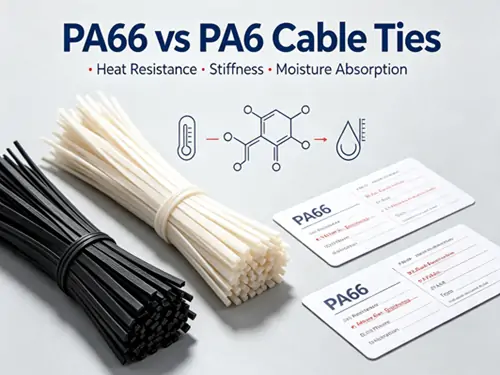
Nylon 66, the most common material used in cable ties, is a hygroscopic polymer—it absorbs and releases moisture from the surrounding air until it reaches equilibrium with the ambient relative humidity. This moisture content directly affects the tie's mechanical behavior.
Moisture and flexibility. Freshly molded nylon contains very little moisture. In this dry state, the material is strong but relatively brittle. As the tie absorbs moisture from the air, it becomes more flexible and impact-resistant. This is why manufacturers condition nylon ties to a specific moisture content—typically around 2.5% by weight for PA66—before packaging. A tie stored in excessively dry conditions loses this conditioning moisture and reverts to a brittle state. Conversely, a tie stored in very high humidity absorbs excess moisture, which can cause dimensional changes and reduce tensile strength.
Temperature effects. Elevated storage temperatures accelerate the rate at which nylon loses its conditioned moisture. They also increase the rate of oxidation, a chemical process that breaks polymer chains over time. A storage area that regularly exceeds 35°C (95°F) can significantly shorten the useful life of nylon ties, even if the ties never leave the box.
UV exposure. Unprotected nylon degrades rapidly under ultraviolet radiation from sunlight or certain types of fluorescent lighting. The UV energy breaks chemical bonds in the polymer, causing surface cracking, discoloration, and loss of tensile strength. Black ties resist UV better than lighter colors because the carbon black pigment absorbs UV before it can penetrate deep into the material. Natural and white ties offer minimal UV protection and should be stored in light-blocking containers if exposure is possible.
Practical Storage Guidelines
Translating the material science into warehouse and job-site practices yields a set of straightforward storage rules:
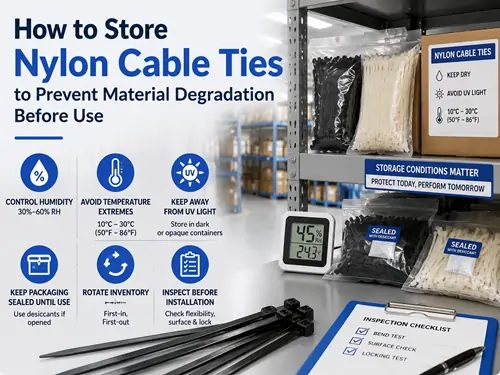
Control humidity. Store nylon ties in an environment with relative humidity between 30% and 60%. This range maintains the material's conditioned moisture content without encouraging excessive water absorption. In arid climates or heated indoor spaces during winter, humidity can drop well below this range. In coastal or tropical locations, humidity routinely exceeds it. A simple hygrometer placed in the storage area provides a quick daily check.
Avoid temperature extremes. The ideal storage temperature range is 10°C to 30°C (50°F to 86°F). Storage areas directly adjacent to exterior walls, under uninsulated roofs, or near heat-generating equipment may experience temperature swings outside this range even when the general warehouse climate is controlled. Keep ties away from radiators, furnace vents, steam pipes, and direct sunlight through windows.
Keep packaging sealed until use. Most nylon ties are packaged in sealed plastic bags that maintain the manufacturer's conditioned moisture level. Once opened, the ties begin exchanging moisture with the ambient air. For facilities that use ties in small quantities over extended periods, consider resealing partially used bags with desiccant packs or transferring ties to airtight containers. For high-volume users, plastic fastening products with sealed bulk packaging help maintain consistent material properties from first piece to last.
Block all light sources. Store ties in opaque containers or sealed cartons. Do not leave bags of ties on open shelving near windows, under skylights, or directly beneath unshielded fluorescent fixtures. Even indirect ambient light accumulates UV exposure over weeks and months. If warehouse racking is exposed to natural light, specify black UV-stabilized ties for those storage locations or install light-blocking curtains.
Rotate inventory. First-in, first-out inventory rotation prevents older stock from sitting unused while newer shipments are consumed. Mark incoming shipments with receipt dates and train warehouse staff to pick from the oldest stock first. While nylon ties do not have a strict expiration date, their properties gradually drift over extended storage. A practical guideline is to use ties within two years of the manufacture date when stored under the conditions described above.
Special Considerations for Different Environments
Outdoor job-site storage. Construction sites, solar installation yards, and telecommunications tower staging areas rarely offer climate-controlled storage. In these environments, store ties in sealed job boxes or weatherproof containers. Avoid leaving opened bags in vehicle cabs where solar heating can push temperatures above 50°C (122°F) within minutes.
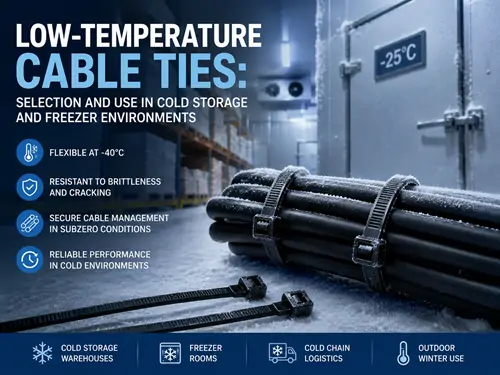
Cold-climate storage. Nylon becomes less flexible at low temperatures, a characteristic independent of moisture content. Ties stored in unheated warehouses during winter should be brought to room temperature before installation. A tie that feels stiff and uncooperative at 0°C may perform perfectly at 20°C. This is not a material defect—it is a temporary physical response to temperature.
High-humidity regions. In tropical and subtropical climates, sealed packaging with desiccant is essential. Once opened, ties should be consumed within days rather than weeks. For facilities in these regions, ordering ties in smaller, sealed package sizes that match typical daily usage rates minimizes the amount of material exposed to humid ambient air.
Inspection Before Installation
Even with proper storage, a visual and tactile inspection before installation catches problems before they reach the application point:
-
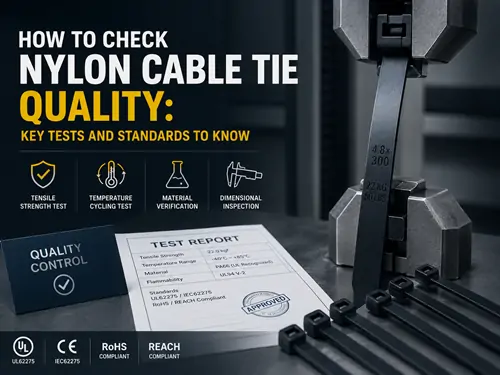
Bend test: Remove a single tie from the batch and bend it sharply. A properly conditioned tie flexes without cracking or whitening at the bend point. If the tie snaps or shows stress marks, the material may be too dry.
-
Surface check: Look for discoloration, chalkiness, or fine cracks on the tie surface. These indicate UV damage or chemical degradation.
-
Locking test: Insert the tail into the pawl and pull to moderate tension. The pawl should engage smoothly and hold without slipping or cracking.
If a sample fails any of these checks, the entire batch should be evaluated before use.
From Storage Practice to Installation Reliability
The mechanical performance of a cable tie at the moment of installation is the product of every environmental condition it has experienced since leaving the factory. Storage conditions are the longest and most variable part of that journey. Controlling humidity, temperature, and light exposure in storage is not an additional task layered onto inventory management—it is a direct investment in the reliability of every connection those ties will secure. When specifying replacement stock or expanding inventory, selecting industrial cable ties with durable sealed packaging supports the storage practices that preserve material performance.
Disclaimer
The storage recommendations in this article represent general best practices based on the material properties of nylon 66 and industry experience. Specific storage requirements may vary by product formulation, manufacturer specifications, and application criticality. This article is provided for informational purposes only. Always follow the manufacturer's storage and handling instructions provided with your specific product. For safety-critical applications, consult the product manufacturer directly regarding storage validation and shelf-life testing.