English
 Español
 Français
 Português
 Pусский
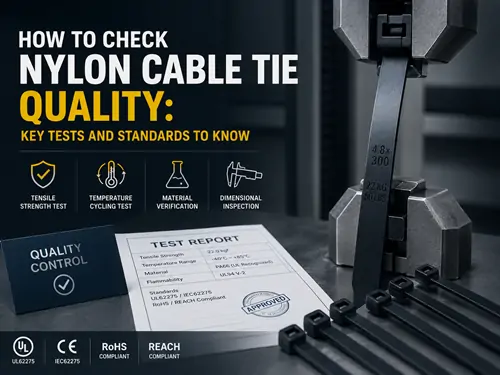
How to Check Nylon Cable Tie Quality: Key Tests and Standards to Know
When sourcing nylon cable ties for industrial use, price and delivery time are important—but they mean nothing if the product fails in service. The most reliable way to verify cable tie quality before committing to a large order is to request documented test results for tensile strength, temperature cycling performance, and material certification. Reputable manufacturers should be able to provide these records as part of their standard quality documentation. This guide explains what tests matter, what standards apply, and what documentation you should request from your supplier.
Why Quality Verification Matters
Cable ties may appear simple, but they perform a critical function: securing cables, hoses, and components in environments that can involve temperature extremes, vibration, chemical exposure, and sustained mechanical load. A tie that fails—whether by breaking, loosening, or becoming brittle—can cause equipment downtime, safety hazards, or costly rework.
Manufacturing quality varies significantly between suppliers. Differences in raw material grade, molding process control, and post-production handling all affect the final product. Without verification, buyers have no way of knowing whether the ties they receive match the specifications they ordered.
For a detailed overview of Boese's quality control processes and test capabilities, visit the quality assurance page.
Key Tests for Nylon Cable Tie Quality
Reputable manufacturers conduct a range of tests to verify product quality. The following tests are the most relevant for buyers to understand and request documentation on.
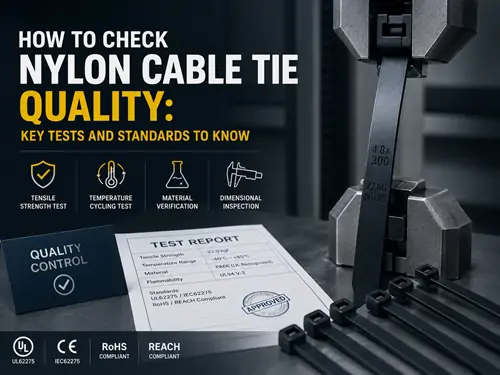
1. Tensile Strength Testing
Tensile strength is the most fundamental performance metric for a cable tie. It measures the maximum load the tie can withstand before breaking. Tensile strength is determined primarily by the tie's dimensions (width and thickness) and material grade.
What to look for: Request tensile strength test reports that specify the test method used (typically ASTM or ISO standards). The reported value should match the published specification for the tie size. For critical applications, consider testing samples from each production batch to verify consistency.
2. Temperature Cycling Testing
Nylon cable ties are rated for specific continuous use temperature ranges. A standard nylon tie typically operates between -40°C and +85°C. Temperature cycling testing verifies that the tie maintains its mechanical properties after repeated exposure to temperature extremes.
What to look for: Request documentation that shows test conditions—including temperature range, number of cycles, and duration. The test should simulate the actual temperature range the tie will experience in your application.
3. Material Verification
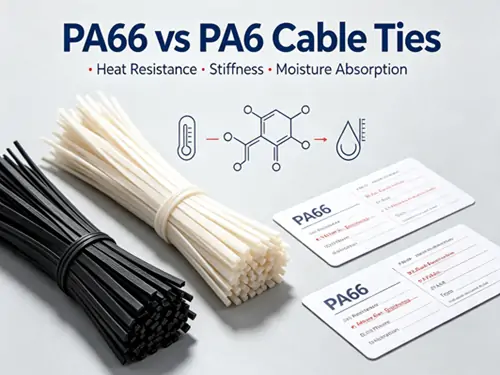
The base material determines many of the tie's performance characteristics. PA66 offers higher heat resistance and lower moisture absorption than PA6. Material verification confirms that the tie is made from the specified material grade.
What to look for: Request material certificates or test reports from the manufacturer. Established manufacturers source raw materials from verified suppliers. Boese, for example, uses UL-approved nylon 66 imported from Italy.
4. Dimensional Inspection
Tie dimensions—width, thickness, and length—must conform to specifications. Dimensional variations can affect tensile strength and fit with the application's bundling requirements.
What to look for: Request dimensional inspection records from production batches. Verify that the dimensions fall within specified tolerances.
5. UV and Weathering Resistance
For outdoor applications, UV resistance is critical. Standard natural nylon degrades under sunlight, becoming brittle and losing strength. UV-stabilized black ties are designed to resist this degradation.
What to look for: Confirm that ties intended for outdoor use are UV-stabilized. Request UV resistance test data if available.
Applicable Standards
Cable tie quality is governed by several international and industry-specific standards. Understanding these standards helps buyers set clear expectations with suppliers.
| Standard | Scope | Relevance |
|---|---|---|
| UL62275 | US standard for cable ties and accessories | Verifies that ties meet fire safety and mechanical requirements for electrical installations |
| CEI/IEC62275 | International standard for cable management systems | Equivalent to UL62275, used in Europe and other regions |
| QB/T4494-2013 | Chinese light industry standard for nylon cable ties | Specific to the Chinese market, covers dimensions and performance |
| CB/T3496-92 | Chinese shipbuilding industry standard | For marine and offshore applications |
| GB/T22344-2008 | Chinese national standard for cable ties | General requirements for nylon cable ties |
What to look for: Ask your supplier which standards their products comply with and request the relevant certification documents. Compliance with multiple standards—particularly UL62275 and IEC62275—indicates a higher level of quality assurance.
Quality Documentation to Request from Suppliers
Before finalizing a purchase, consider requesting the following quality documents from your supplier:
- Material certificates confirming the raw material grade and source
- Tensile strength test reports from a recognized test method, showing results for the specific tie sizes you are ordering
- Temperature cycling test reports showing test conditions and results
- Certification documents including UL, CE, RoHS, REACH, or other relevant certifications
- Incoming material inspection records confirming the supplier's quality control process
- In-process quality records from production monitoring
- Dimensional inspection records from the production batch
For answers to common questions about ordering, MOQ, and product specifications, visit the FAQ page.
Red Flags to Watch For
Be cautious if a supplier:
- Cannot provide test reports or certification documents
- Provides only generic certificates that do not reference specific product sizes
- Avoids questions about raw material source
- Cannot specify which standards their products comply with
- Offers significantly lower prices without a clear explanation
Frequently Asked Questions
Q: What is the most important test for nylon cable tie quality?
A: Tensile strength testing is the most critical single test, as it directly measures the tie's load-bearing capability. However, a comprehensive quality evaluation should include temperature cycling, material verification, and dimensional inspection as well.
Q: What tensile strength should I expect from a standard nylon cable tie?
A: Tensile strength varies by tie dimensions. A common 4.8mm x 300mm nylon cable tie typically has a tensile strength of about 22 kg (50 lbs). Always check the specific rating for the size you are ordering—tensile strength scales with width and thickness.
Q: What does UL62275 certification mean?
A: UL62275 is the US safety standard for cable ties and cable management accessories. Certification verifies that the ties meet fire safety and mechanical performance requirements for electrical installations. UL certification involves ongoing factory inspections, not just initial testing.
Q: How can I verify that the material is PA66 rather than PA6?
A: Request material certificates from the supplier's raw material source. Some manufacturers also perform differential scanning calorimetry (DSC) testing to confirm melting point, as PA66 melts at approximately 262°C versus 220°C for PA6.
Q: What causes nylon cable ties to degrade?
A: Several factors can degrade nylon cable ties: prolonged UV exposure (outdoor sunlight), high temperatures above the rated range, chemical exposure from cleaning agents or industrial environments, and moisture absorption in humid conditions.
Q: How often should I test cable ties from my supplier?
A: For critical applications, testing each production batch is recommended. For less critical applications, periodic spot testing—at least annually or when changing suppliers—provides a reasonable quality check.
Conclusion
Quality verification for nylon cable ties comes down to three key areas: tensile strength performance, temperature resistance, and material integrity. The most reliable way to confirm quality is to request documented test results from your supplier and verify that they align with published specifications and relevant standards.
When evaluating potential suppliers, look for manufacturers that provide comprehensive quality documentation—including material certificates, test reports, and certification records. This documentation not only confirms product quality but also indicates the manufacturer's commitment to quality management. Facilities that operate under ISO9001 and ISO14001 are more likely to maintain consistent quality practices.
For specific applications with unusual temperature ranges, chemical exposure, or regulatory requirements, request testing that simulates your actual conditions. When in doubt, ask the manufacturer for guidance—they can help match the right tie to your application requirements.
To review Boese's quality control processes and test capabilities, visit the quality assurance page. For questions about specific test requirements or to request documentation for a particular product, contact the sales team directly. For more information about the company and its product range, visit the Boese official website.
Disclaimer: This article is provided for general informational purposes only and does not constitute professional engineering advice, quality certification, or product warranty. Test methods, standards, and performance criteria mentioned are based on general industry practices and publicly available information. Buyers should independently verify all product specifications, test results, and certifications with their supplier and, where appropriate, engage qualified professionals to assess product suitability for their specific applications. Performance claims and test data referenced from manufacturers should be confirmed directly with the relevant supplier.