English
 Español
 Français
 Português
 Pусский
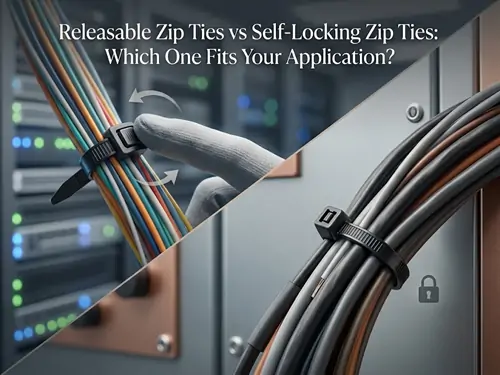
Releasable Zip Ties vs Self-Locking Zip Ties: Which One Fits Your Application?
When choosing cable ties for a project, one of the first decisions is whether you need a permanent fastening or the ability to release, adjust, and reuse the tie. The answer determines whether you should specify releasable zip ties or standard self-locking zip ties. Both are made from nylon PA66 and carry similar certifications, but they differ fundamentally in their locking mechanism, reusability, and the applications they serve.
1. The Core Difference: Locking Mechanism
The defining difference between the two types lies in how they lock—and whether that lock can be undone.
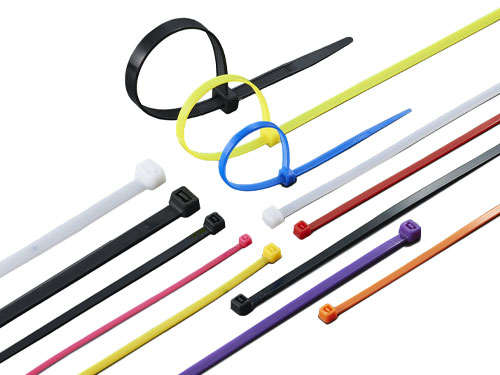
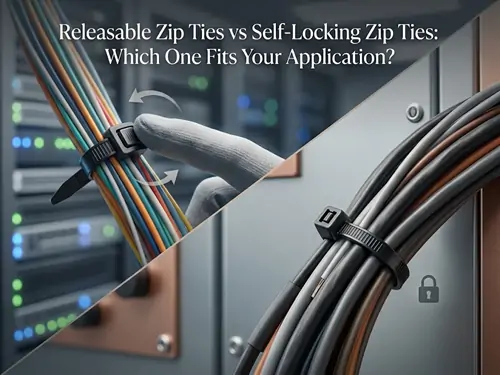
Self-locking zip ties use a one-way pawl-and-ratchet mechanism. Once the tail is pulled through the head, small teeth engage and prevent the tie from loosening. The only way to remove it is to cut it off. The Boese product page describes this as a "buckle self-locking design" with "clear gear for secure locking." Once tensioned, the tie becomes a permanent fixture.
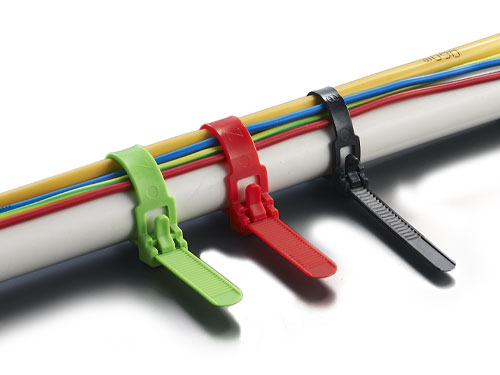
Releasable zip ties use a push-button release mechanism built into the head. Pressing the release tab disengages the pawl from the strap teeth, allowing the tie to be loosened, repositioned, and retightened—or fully removed and reused. The Boese product page states: "Releasable cable ties feature an easy push-button release mechanism that allows you to loosen, re-adjust, and reuse the tie. These cable ties are just as strong and secure as standard cable ties, but have the added advantage of releasing and reusing them."
This single design difference drives most of the application decisions between the two types.
2. Specification Comparison
Based on the technical data from both Boese product pages, here is a side-by-side comparison:
| Feature | Releasable Zip Ties | Self-Locking Zip Ties |
|---|---|---|
| Material | Nylon 66, UL 94V-2 certified | PA66, UL 94V-2 certified |
| Locking mechanism | Push-button release, reusable | Pawl-and-ratchet, permanent |
| Reusability | Can be released, adjusted, and reused multiple times | Single-use—must be cut to remove |
| Width range | 7.2mm – 8.0mm | 2.5mm – 9.0mm |
| Length range | 150mm – 400mm (6" – 15 3/4") | 80mm – 1020mm (3.2" – 40.1") |
| Tensile strength | 50 lbs (22 kg) | 18 lbs – 175 lbs (8 kg – 79.4 kg) |
| Working temperature | -40℃ to 100℃ | -35℃ to 80℃ |
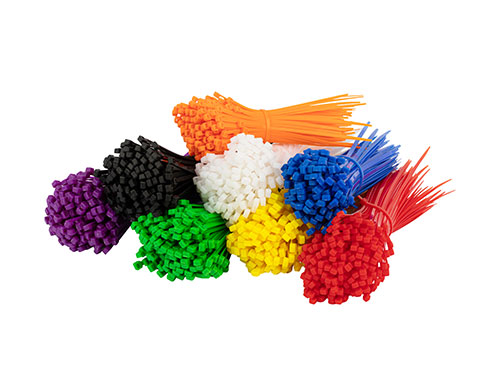
| Color options | Natural, black | Natural, black, all colors available |
| Certifications | CE, SGS, UL, ISO9001 | CE, SGS, UL, ISO9001 |
| Head design | Oval, low-profile with release tab | Standard pawl-and-ratchet head |
| Typical packaging | 100 pcs/bag | 100 pcs/bag |
All data sourced from Boese product pages. Actual specifications should be confirmed with the supplier for specific sizes.
The most notable differences are in width/length range and tensile strength options. Self-locking zip ties are available in a much wider variety of sizes—from tiny 2.5mm-wide ties for delicate electronics work to heavy-duty 9.0mm-wide ties rated for 175 lbs. The releasable range is more focused, with 7.2mm and 8.0mm widths at a consistent 50 lb tensile rating.
3. When to Choose Self-Locking Zip Ties
Self-locking ties are the right choice when the fastening is intended to be permanent and cost per tie is a consideration. Typical applications include:
- Control panel wiring – Bundling cables inside enclosures where access is only needed during major rework
- Automotive harness assembly – Permanent wire routing in vehicles where vibration resistance is critical
- Outdoor installations – Securing cables to poles, fences, or conduit where ties are exposed to weather
- Mass production bundling – High-volume applications where ties are applied once and never adjusted
- Packaging and shipping – Temporary bundling that is cut off by the end user
Self-locking ties are also the practical choice when you need a wide range of sizes. The Boese self-locking range covers lengths from 80mm to over 1,000mm, accommodating bundle diameters from a few millimeters to 300mm. For very small or very large bundles, self-locking is often the only option.
4. When to Choose Releasable Zip Ties
Releasable ties excel in situations where cables or bundles will be accessed, modified, or reconfigured over time. The Boese product page highlights that these ties are designed for "air handling spaces (plenum) and flexible conduit and cable support and wire bundling." Common applications include:
- Network and data center cabling – Cable trays and racks where moves, adds, and changes are frequent
- Temporary installations – Event setups, trade show displays, and temporary electrical work
- Maintenance and service access – Bundles that must be opened periodically for inspection or repair
- Prototyping and R&D labs – Test setups where cable routing changes frequently
- Cable management trays – Situations where cables are added or removed over time
The Boese product page also notes that releasable ties feature an "oval, low profile head" that "eliminates snags" and is "easier to pull through bulkheads." The rounded tip "prevents users from cutting themselves on sharp edges, and makes it easier to insert into hard-to-reach places."
The single-width focus (7.2mm/8.0mm at 50 lbs) makes these ties well-suited for medium-duty cable management—they are not intended for either very light or very heavy bundling tasks.
5. Making the Decision: A Practical Guide
Ask yourself these questions when choosing between the two types:
Will the bundle need to be accessed or modified in the future?
- Yes → Consider releasable zip ties
- No → Self-locking zip ties are appropriate
What bundle diameter and tensile strength do you need?
- Very small (under 22mm) or very large (over 105mm) → Self-locking offers the necessary size range
- Medium bundles (35mm – 105mm) at moderate load → Either type can work
What is the working environment?
- High temperature (above 80℃) → Releasable has the wider range (-40℃ to 100℃)
- Cold environment (below -35℃) → Self-locking has the lower minimum (-35℃ vs -40℃)
Is cost per tie a primary concern for high-volume, one-time use?
- Yes → Self-locking typically provides more sizes and options at lower per-unit cost
- No, reusability adds value → Releasable pays for itself through repeated use
If you're working with standard cable bundles in network cabinets, control panels, or maintenance-prone areas, you can view the releasable nylon cable ties product details for specifications on the push-button release mechanism. For permanent fastening across a broader size range, review the self-locking nylon cable zip tie specifications.
Frequently Asked Questions
Q: Are releasable zip ties as strong as self-locking zip ties?
A: The Boese product pages show that releasable ties are rated at 50 lbs (22 kg) tensile strength. Self-locking ties range from 18 lbs to 175 lbs depending on width. At equivalent widths, the strength is comparable—the difference is in the size range available, not the strength of the locking mechanism itself.
Q: How many times can a releasable zip tie be reused?
A: The product page does not specify a maximum number of cycles. The mechanism is designed for repeated use, but actual service life depends on how the tie is handled, the load applied, and the environment. Inspect the release tab and teeth for wear before reusing in critical applications.
Q: Can self-locking zip ties be removed without cutting?
A: No. The one-way pawl-and-ratchet design is permanent. The only removal method is to cut the tie, which destroys it.
Q: Do both types use the same material?
A: Yes, both are made from nylon 66 (PA66) with UL 94V-2 flame retardant certification, according to the Boese product specifications. Both carry CE, SGS, UL, and ISO9001 certifications.
Q: Why are there fewer size options for releasable zip ties?
A: The push-button release mechanism requires a specific head design that works reliably at certain strap widths. The 7.2mm and 8.0mm widths represent a balance between mechanism reliability and practical cable management needs.
Conclusion
Releasable and self-locking zip ties are not competing products—they serve different purposes in cable management. Choose self-locking ties for permanent installations, wide size ranges, and high-volume cost-sensitive applications. Choose releasable ties when bundles will need future access, adjustment, or reconfiguration, and when the convenience of reusability outweighs the higher per-unit cost.
Most facilities benefit from keeping both types on hand: self-locking for production and permanent installations, releasable for maintenance, prototyping, and dynamic environments. The key is matching the locking mechanism to how the bundle will actually be used over its lifetime.
If you need help determining which type fits your specific application, contact Boese to discuss your cable management requirements.