English
 Español
 Français
 Português
 Pусский
PA66 vs PA6 Nylon Cable Ties: Material Differences and Selection Guide
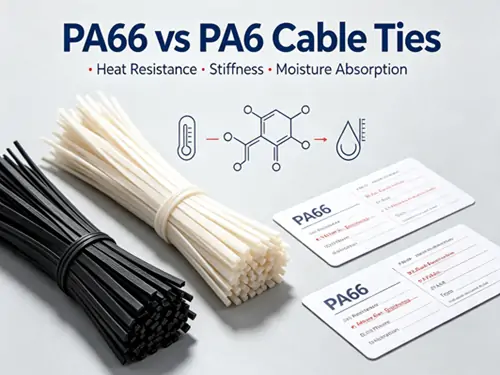
When selecting nylon cable ties for an industrial application, one of the most common questions procurement teams and engineers face is whether to choose PA66 or PA6 material. The short answer is: PA66 offers higher heat resistance, greater stiffness, and lower moisture absorption, making it the preferred choice for demanding industrial and outdoor applications, while PA6 provides better impact resistance and is more cost-effective for less demanding uses. However, the right choice depends on your specific operating conditions, temperature range, and mechanical requirements.
This guide explains the material differences between PA66 and PA6 nylon cable ties, how these differences affect real-world performance, and what factors you should consider before making a purchasing decision.
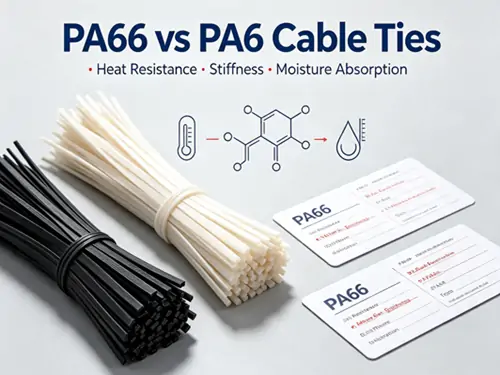
Understanding Nylon 66 (PA66) and Nylon 6 (PA6)
Both PA66 and PA6 are polyamide materials commonly used in cable tie manufacturing. They share many characteristics—excellent abrasion resistance, good chemical resistance, and reliable mechanical strength—but their molecular structures create distinct performance profiles.
PA66 (Polyamide 66) is polymerized from hexamethylenediamine and adipic acid. Its molecular chain structure provides higher crystallinity, which translates to greater stiffness, higher melting point, and better thermal dimensional stability.
PA6 (Polyamide 6) is polymerized from caprolactam. Its molecular structure allows for more flexibility and better impact resistance, but with a lower melting point and higher moisture absorption rate.
Key Differences at a Glance
| Property | PA66 (Nylon 66) | PA6 (Nylon 6) |
|---|---|---|
| Melting point | ~262°C | ~220°C |
| Continuous use temperature | -40°C to +85°C (up to +150°C for specialized grades) | -40°C to +80°C |
| Stiffness | Higher (12% harder than PA6) | Lower, more flexible |
| Impact resistance | Moderate | Better |
| Water absorption | Lower, better dimensional stability | Higher, poorer dimensional stability |
| Chemical resistance | Better oil resistance | Better resistance to some chemicals |
| UV resistance | Requires UV stabilization for outdoor use | Requires UV stabilization for outdoor use |
| Cost | Higher | Lower (typically ~30% less) |
Temperature Range: Why It Matters
Temperature is one of the most critical factors in cable tie selection. The operating temperature range determines whether a cable tie will maintain its tensile strength or become brittle and fail.
For standard nylon cable ties, the working temperature range is typically -40°C to +85°C. However, there is an important distinction that many buyers overlook:
- Continuous use temperature: The temperature range within which the cable tie can maintain its mechanical properties over extended periods.
- Installation temperature: The ambient temperature at which the cable tie should be installed. Installation below 0°C can make the material brittle and prone to cracking during tightening.
PA66 maintains its structural integrity better at elevated temperatures. While PA6 may start to soften or lose its gripping force at high temperatures, PA66 retains its mechanical properties. This is why PA66 is the preferred material for automotive engine compartments, industrial machinery, and other high-temperature environments.
For specialized high-temperature applications, Boese offers high-temperature cable ties that withstand continuous exposure up to 170°C, and PA12 cable ties rated for 105°C continuous use. For extreme cold environments down to -40°C, specially engineered low-temperature cable ties are available.
Moisture Absorption and Dimensional Stability
Nylon materials are hygroscopic—they absorb moisture from the environment. This is a critical consideration because moisture absorption affects dimensional stability and mechanical properties.
PA66 absorbs less moisture than PA6, making it much more predictable in humid or outdoor environments. PA6's higher water absorption rate means its dimensions can change more significantly with humidity fluctuations, potentially affecting the tightness of the bundle over time.
For applications in high-humidity environments, outdoor installations, or locations with frequent temperature cycling, PA66's lower moisture absorption provides a significant reliability advantage.
Tensile Strength and Mechanical Performance
Both PA66 and PA6 cable ties offer excellent tensile strength, but PA66 generally provides higher stiffness and better resistance to creep (permanent deformation under sustained load). The tensile strength of a cable tie is primarily determined by its dimensions (width and thickness) and material grade.
Boese's nylon cable ties are manufactured from UL-approved nylon 66 imported from Italy, ensuring consistent material quality and reliable mechanical performance. The company implements strict quality control measures, including daily sampling and high-low temperature cycle testing.
Application Suitability
| Application Environment | Recommended Material | Reason |
|---|---|---|
| Automotive engine compartments | PA66 | High temperature resistance |
| Outdoor installations | PA66 (UV-stabilized) | Lower moisture absorption, better durability |
| Food and pharmaceutical | PA66 (metal-detectable) | Meets HACCP requirements, detectable |
| General indoor cable management | PA6 or PA66 | Both suitable; PA6 more cost-effective |
| High-humidity environments | PA66 | Better dimensional stability |
| Chemical plants | PA66 | Better oil and chemical resistance |
| Cold storage / freezer | Special low-temperature PA | Remains flexible at -40°C |
Common Selection Mistakes to Avoid
- Ignoring installation temperature: Installing cable ties in cold conditions (below 0°C) can cause cracking. Always check the minimum installation temperature specification.
- Confusing continuous use temperature with peak temperature: A cable tie may survive brief exposure to higher temperatures but will fail if exposed continuously beyond its rated range.
- Overlooking UV exposure: Standard natural-color nylon cable ties degrade under sunlight. For outdoor applications, always specify UV-resistant black cable ties.
- Choosing solely based on cost: While PA6 is approximately 30% less expensive than PA66, the cost savings may be offset by premature failure in demanding applications.
Quality Verification Checklist
Before finalizing your cable tie selection, consider the following verification steps:
- Confirm the continuous operating temperature range of the application
- Verify the installation temperature at the job site
- Check if UV exposure is a factor (outdoor vs. indoor)
- Assess humidity levels and moisture exposure
- Determine the required tensile strength based on bundle weight
- Verify relevant industry standards (UL62275, IEC62275, etc.)
- Confirm if special requirements apply (metal detectable, flame retardant, etc.)
For a detailed overview of Boese's quality control process, visit the quality assurance page.
Frequently Asked Questions
Q: What is the main difference between PA66 and PA6 cable ties?
A: PA66 offers higher heat resistance (melting point ~262°C vs ~220°C), greater stiffness, and lower moisture absorption than PA6. PA6 provides better impact resistance and is more cost-effective.
Q: Can PA6 cable ties be used outdoors?
A: Yes, but only if they are UV-stabilized (typically black in color). Standard natural PA6 cable ties will degrade under prolonged sunlight exposure. PA66 with UV stabilization generally offers better outdoor durability due to lower moisture absorption.
Q: What temperature can nylon cable ties withstand?
A: Standard nylon cable ties operate between -40°C and +85°C. Specialized high-temperature grades can withstand up to 170°C, and low-temperature grades remain flexible at -40°C.
Q: Why does moisture matter for nylon cable ties?
A: Nylon absorbs moisture, which can affect dimensional stability and mechanical properties. PA66 absorbs less moisture than PA6, making it more reliable in humid environments.
Q: How do I know which material my application needs?
A: Consider your operating temperature range, humidity levels, UV exposure, and mechanical load requirements. For most demanding industrial applications, PA66 is the preferred choice. For general indoor use with moderate conditions, PA6 may be sufficient and more economical.
Q: Does Boese offer both PA66 and PA6 cable ties?
A: Boese primarily manufactures cable ties from UL-approved nylon 66 (PA66). For specific requirements, discuss your application needs with the sales team to determine the most suitable material option.
Conclusion
Choosing between PA66 and PA6 nylon cable ties comes down to understanding your application's specific demands. PA66 is the superior choice for high-temperature environments, outdoor installations, high-humidity conditions, and applications requiring maximum dimensional stability. PA6 offers a more economical solution for general indoor use where temperature and moisture are not critical factors.
Before making a final decision, verify your operating temperature range (both installation and continuous use), assess environmental factors like UV exposure and humidity, and confirm any industry-specific requirements. When in doubt, consult with the manufacturer—they can help match the right material to your specific application conditions.
To explore the available nylon cable tie product page configurations. For application-specific recommendations or to discuss your requirements, contact the Boese sales team directly.