English
 Español
 Français
 Português
 Pусский
How to Choose a Stainless Steel Tie for Corrosive Environments
Metal fasteners used in bundling applications face a wide range of environmental conditions. Some installations sit in climate-controlled indoor spaces where corrosion is never a concern. Others are exposed to salt-laden coastal air, chemical plant atmospheres, or the sustained heat of industrial process equipment. In these demanding settings, the difference between a fastener that lasts a decade and one that fails in eighteen months often comes down to the specifications that were checked—or overlooked—at the time of selection.
The term "stainless" covers multiple alloys, coatings, and mechanical designs. Relying on it as a catch-all description without defining the grade, coating type, and locking mechanism invites premature replacement costs. This guide examines the four factors that determine whether a metal bundling solution will hold up in chemically aggressive, high-humidity, or high-temperature conditions.
1. Material Grade: Why 304 Is Not Always Enough
The two most common stainless alloys used in metal bundling products are 304 and 316. Both contain chromium, which forms a passive oxide layer that protects the underlying steel. The critical difference is molybdenum.
304 stainless contains approximately 18% chromium and 8% nickel. In mild outdoor conditions, light industrial atmospheres, and freshwater contact, this grade performs reliably for years. The oxide layer regenerates when scratched, providing ongoing protection.
316 stainless adds 2-3% molybdenum to the alloy. This addition significantly improves resistance to chloride-induced pitting, the specific failure mechanism that attacks metal in coastal air, de-icing salt exposure, and many chemical processing environments. Under salt spray testing, 316 fasteners can withstand 400-600 hours before showing red rust, compared to 100-200 hours for 304 under the same conditions. This difference translates directly to service life.
For environments involving direct chemical contact, the grade decision should be guided by a chemical compatibility chart that lists the specific media—acids, alkalis, solvents—and the recommended alloy for each. No single stainless grade resists everything, and assumptions based on general "corrosion resistance" labels are a common source of field failures.
When selecting a stainless steel tie for a corrosive application, the starting question is not "304 or 316" in the abstract. It is "316 plus what coating, given the specific chemical exposure."
2. Coating Selection: PVC, Epoxy, or No Coating
A bare metal fastener in direct contact with a dissimilar metal—such as a stainless tie on a galvanised steel cable tray—creates a galvanic couple. In the presence of moisture, the less noble metal corrodes preferentially. A coating breaks the electrical path between the two metals, preventing this mechanism.
Polyvinyl chloride (PVC) coatings are the most common choice for general chemical resistance. PVC resists many acids, alkalis, and salt solutions while providing a degree of cushioning against vibration and abrasion. The coating thickness, typically 0.3 mm to 0.5 mm, adds a small amount to the overall tie profile but contributes significantly to service life in aggressive atmospheres.
Epoxy coatings offer superior performance at elevated temperatures and against specific chemical agents that attack PVC. Epoxy provides a harder, more abrasion-resistant surface, making it suitable for installations subject to mechanical wear as well as chemical exposure. The trade-off is flexibility: epoxy-coated ties are less tolerant of repeated bending during installation than PVC-coated equivalents.
The decision to use an uncoated metal tie should be deliberate, not a default. An uncoated tie makes sense when nothing in the environment attacks the alloy itself, when the bundled materials are also stainless and thus present no galvanic risk, or when the installation is indoors in a controlled atmosphere. In outdoor, coastal, or chemical-processing environments, the cost of an uncoated tie is measured in the shorter interval between replacements.
3. Locking Mechanism: Ball Lock and Its Sealing Implications
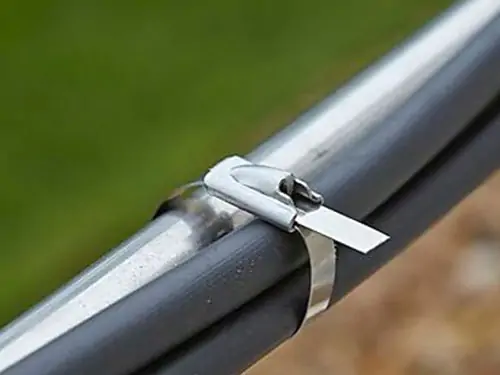
Metal fastening products used in corrosive service typically employ a ball-lock mechanism. A stainless ball bearing, housed in a formed head, rolls along the tie body as it is inserted. When tension is applied, the ball bites into the tie body, creating a permanent lock. This design has no plastic components to degrade under UV or chemical attack.
The ball-lock mechanism matters for corrosion resistance in a way that is easy to overlook: crevice corrosion. The small gap between the ball and the tie body, or between the head and the inserted tail, can trap moisture and chemical residue. In chloride-rich environments, these micro-crevices become initiation points for pitting, even on 316 material.
Epoxy-coated ball-lock designs address this by filling the head cavity with coating material, reducing the crevice volume. Some manufacturers also offer a fully coated head option, where the coating extends over the locking mechanism after installation. When evaluating a corrosion-resistant metal tie, examine whether the locking head design minimises trapped volume and whether coating continuity is maintained through the locking area.
4. Temperature Compatibility
Chemical resistance and temperature tolerance are linked in practice. A coating that resists a specific acid at 25°C may soften, swell, or delaminate when the same acid is present at 80°C. This is particularly relevant in chemical processing, where pipe and vessel exteriors can operate at elevated temperatures.
PVC coatings typically have a continuous service temperature limit of approximately 85°C. Beyond this point, the plasticiser content in the PVC begins to migrate, the coating becomes brittle, and cracking can expose the underlying metal. Epoxy coatings extend the upper limit to approximately 150°C, depending on the specific formulation.
For fire-protection applications, the temperature requirement shifts from continuous service to survivability under extreme conditions. Metal ties used to secure fire-rated cable bundles must maintain integrity long enough for the protected circuit to perform its safety function. In these scenarios, uncoated 316 ties are often specified because coatings may melt or ignite, compromising the bundling function when it is most needed.
5. Installation Practices That Preserve Corrosion Resistance
Even the best-specified fastener can fail early if installation introduces damage. Three common mistakes accelerate corrosion.
First, over-tensioning stretches the tie body, thinning the cross-section and creating stress concentrations. In a corrosive atmosphere, stress corrosion cracking can initiate at these points. Following the manufacturer's specified tension range, typically verified with a calibrated tensioning tool, prevents this.
Second, cutting the excess tail with steel side-cutters leaves a sharp edge where the coating—if present—is breached. The exposed steel at the cut end becomes a corrosion initiation site. Flush-cutting with the correct tool and, where practical, orienting the cut end downward so that moisture drains away from it, helps manage this vulnerability.
Third, contact with dissimilar metals during storage or installation can embed iron particles on the stainless surface. These particles rust, and the rust stain spreads across the tie even though the underlying alloy remains intact. This is primarily a cosmetic issue, but in food-processing or pharmaceutical environments, any visible rust is unacceptable. Dedicated stainless-only tooling and clean storage conditions prevent cross-contamination.
For anyone specifying metal fastening solutions, these installation details are as important as the material specification itself. A correctly chosen alloy and coating can be undermined by a single installation error.
Matching the Fastener to the Exposure
Choosing a bundling solution for a corrosive environment is not about finding the single best product. It is about defining the exposure—chemical agents present, temperature range, mechanical loads, and the consequence of failure—and then matching the grade, coating, and locking mechanism to that exposure.
A 316 tie with an epoxy coating and a properly sealed ball-lock head represents one end of the protection spectrum, suitable for aggressive chemical environments and high-temperature service. A 304 tie with a PVC coating occupies a middle ground, adequate for outdoor industrial environments with moderate chemical exposure. An uncoated 304 tie may be perfectly appropriate for a dry indoor cable tray where corrosion is not a concern.
The consistent thread is that the choice should be deliberate and documented, not left to a generic "stainless" specification on a bill of materials. When the environment is corrosive enough to threaten ordinary fasteners, it is corrosive enough to warrant specifying each element of the solution. Before making a final selection, reviewing detailed specifications for a stainless steel tie range that covers multiple grades, coatings, and locking configurations ensures the chosen product matches the real conditions it will face.