English
 Español
 Français
 Português
 Pусский
Mount Head Cable Ties 101: The Two‑in‑One Solution for Bundling and Securing Cables to Panels
In a typical control panel build, the sequence for securing a cable bundle to the backplate involves three separate actions: wrap the wires with a standard tie, tighten and trim it, then snap a second component – an adhesive‑backed or screw‑fix mount – into position around the tie. Each step introduces a part, a labour movement, and a potential weak point. The adhesive mount may detach when the enclosure warms up, or the separate tie may slip through the mount if the diameters are mismatched.
A mount head cable tie eliminates this multi‑part sequence by combining the bundling strap and the mounting lug into a single moulded component. The strap wraps around the cable bundle and locks in place; a flat head with a pre‑formed hole then accepts a screw or bolt, fixing the entire bundle directly to the panel. This article explains what these fasteners are, how they are specified, and where they deliver the greatest value in electrical and mechanical installations.
What a Mount Head Tie Is
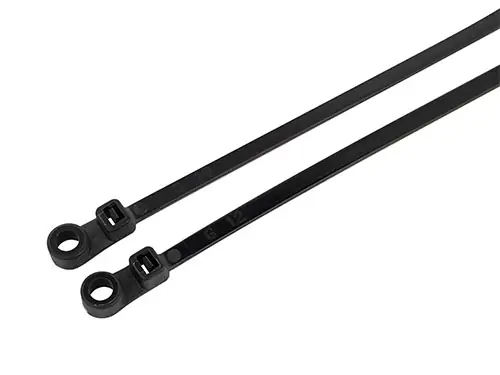
A mount head tie is a one‑piece nylon 66 moulding that integrates a standard locking strap with a flat, perpendicular mounting tab at the head. The tab contains a hole sized for a specific screw diameter – typically M3, M4, or M5, depending on the tie size – so that the entire assembly can be fixed to a panel, chassis rail, or wall surface with a single fastener.
The strap works identically to a standard tie: it feeds through a pawl‑type locking head and ratchets tight. The difference is that once the bundle is secure, the installer does not need to reach for a separate mount or clip. The tie is already the mount.
This design is distinct from push‑mount ties, which use a barbed arrowhead to press into a panel hole without tools. Push‑mount ties are faster for high‑volume assembly lines but require the panel to have a precisely sized hole and sufficient thickness to retain the barb. Screw‑fix mount head ties, by contrast, work on any material that can accept a threaded fastener – metal, wood, plastic – and can be removed and re‑fastened without damaging the fixing point.
Key Specifications and Material
Mount head ties are produced in Nylon 66 (polyamide 66), the same material used for general‑purpose nylon cable ties, but often with a UL 94V‑2 flame‑retardant rating for use inside electrical enclosures. This rating means the material self‑extinguishes within a specified time when a flame source is removed, reducing the risk of fire propagation along cable bundles.
The operating temperature range of -40 °C to 100 °C covers the vast majority of indoor and sheltered outdoor applications. Black variants typically incorporate carbon black for UV resistance, while natural (uncoloured) grades are suitable for indoor use where sunlight is not a factor.
Sizes typically range from approximately 100 mm to 380 mm in strap length, covering bundle diameters from 22 mm to nearly 100 mm. Tensile strength varies with cross‑section: thinner straps (around 3.5 mm wide) hold approximately 18 lbf (8 kgf), while the largest sizes (7.6 mm wide) exceed 120 lbf (55 kgf). These values are measured at room temperature; at elevated temperatures approaching 85 °C, the sustained load capacity should be derated to avoid creep and loosening.
For users who need UL‑certified Nylon 66 mountable cable fasteners in black or natural, covering bundle diameters from 22 mm to 98 mm, the selection can be narrowed by first determining the required bundle diameter and screw size, then verifying the tensile strength against the cable weight and any dynamic loads.
Installation Steps and Best Practices
-
Select the correct screw size. The mounting hole diameter is specified on the product drawing. Using a screw that is too small can allow the tie to shift under vibration; too large, and the screw head may not seat properly.
-
Position the tie before tightening the strap. Because the mounting head is fixed, the installer should hold the tie in position on the bundle, mark or align it with the screw point, and tighten the strap only after the screw is located.
-
Tighten the strap to the recommended tension. Over‑tightening can crush cable insulation, particularly on data or signal cables. A hand‑tightened strap that holds the bundle firmly without deforming the outer jacket is usually sufficient.
-
Trim the tail flush. A protruding tail can snag on adjacent wires or cut an installer’s hand during later maintenance. Use a flush‑cutting tie gun rather than side cutters to leave a smooth, snag‑free edge.
Common Mistakes to Avoid
-
Using the wrong screw thread. Mount head holes are smooth, not threaded. The screw must match the hole diameter and be paired with a nut or driven into a pre‑tapped or self‑tapping hole. Forcing an oversized screw through the hole can crack the nylon head.
-
Mounting on a surface that exceeds the tie’s temperature rating. Even though the ambient air may be within range, a metal panel attached to a motor or transformer can reach localised temperatures above 100 °C. If the mounting surface is hot, the tie head may soften and lose clamping force.
-
Ignoring vibration orientation. On equipment subject to continuous vibration, orient the tie so that the weight of the cable bundle pulls the strap against the locking pawl rather than away from it. This reduces the risk of the pawl ratcheting loose over time.
Where Mount Head Ties Deliver the Most Value
-
Electrical control panels: Bundling and fixing conductors to the backplate in a single operation, reducing the parts count per bundle.
-
Automotive and vehicle wiring harnesses: Securing cable runs to chassis rails where screw‑fix points are already available.
-
Industrial machinery: Fastening sensor and actuator cables to machine frames, where adhesive mounts would fail due to oil or heat.
-
Solar panel installations: Organising DC cables behind modules and attaching them to mounting rails with stainless steel screws.
-
Telecom and data cabinets: Managing patch cord bundles and fixing them to vertical cable managers.
Maintenance and Inspection
A mount head tie, once installed, requires little attention, but periodic inspection of screw tightness is recommended in high‑vibration environments. If a cable bundle needs to be reworked, the strap can be cut and replaced without removing the screw – a new tie of the same size can use the existing screw point. This makes rework faster than with adhesive mounts, which often need to be scraped off and replaced entirely.
For installers and panel builders looking to reduce the number of separate components in their cable management assemblies, Boese’s range of one‑piece mount head cable ties in Nylon 66 with UL 94V‑2 certification provides a documented, repeatable fastening method that combines bundling and fixing into a single step.
A well‑organised cable installation is faster to build, easier to maintain, and less likely to develop faults from chafing or loose wiring. The mount head tie is one of the simplest tools in the cable management kit, and when specified correctly, it removes work steps and failure points simultaneously.