English
 Español
 Français
 Português
 Pусский
How to Choose Releasable Nylon Cable Ties for Outdoor Use
Outdoor installations place demands on fastening components that indoor applications never do. A cable tie securing a junction box on a rooftop, a bundle of irrigation tubing in a garden, or a temporary banner on a fence post must endure UV radiation, temperature swings, moisture, and sometimes wind load—all without failing. Standard nylon ties, widely used indoors, often become brittle and snap after a season or two of sun exposure. Others lose flexibility in cold weather, making adjustments impossible without replacement.
Selecting the right fastening solution for outdoor use requires understanding a few key material and design properties. This guide walks through what matters most—UV resistance, operating temperature range, mechanical strength, and the practical advantage of a releasable mechanism—so you can choose ties that hold up where you need them.
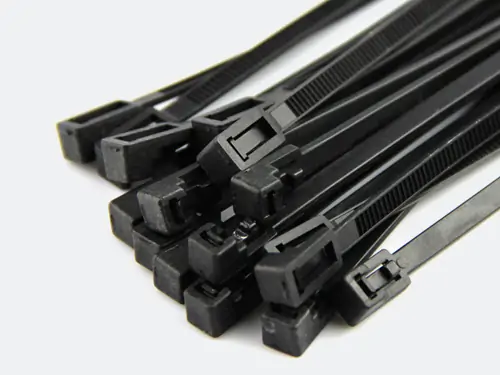
Why Standard Nylon Often Fails Outdoors
Most general-purpose cable ties are made from polyamide 6.6 (PA66), a nylon grade valued for its strength-to-weight ratio and low cost. In stable indoor environments, PA66 performs well. But outdoor conditions expose its two main weaknesses.
First, UV radiation from sunlight degrades the polymer chains in unprotected nylon. Photodegradation causes discolouration (yellowing), surface chalking, and a progressive loss of tensile strength. A tie that initially holds 50 pounds can, after a year of sun exposure, snap under a fraction of that load. The timeline depends on latitude, altitude, and hours of direct sun, but the failure mode is predictable: without UV stabilisation, nylon becomes brittle and fractures.
Second, nylon absorbs moisture from the air. In high humidity or direct rain, PA66 can reach moisture saturation levels of 2.5–3.5% by weight at 50% relative humidity. This moisture acts as a plasticiser—it makes the material more flexible and impact-resistant, but it also reduces tensile strength and stiffness. The dimensional change can loosen a tie over time, particularly when humidity cycles between dry and wet conditions. In applications where consistent clamping force matters (sealing a cable gland, for instance), this swelling and shrinking cycle can be problematic.
Heat accelerates both processes. A dark-colored tie on a sun-exposed metal surface can reach temperatures far above ambient air—often 60°C or higher. At elevated temperatures, nylon oxidises faster, and UV degradation speeds up. Together, these factors make material selection for outdoor fastening a more deliberate choice than simply reaching for the most common tie.
Key Factor 1: UV Stabilisation
The most important characteristic to look for in an outdoor-rated fastening solution is UV resistance. Manufacturers achieve this by adding UV stabilisers to the nylon resin during compounding. The most common and effective is carbon black, typically at a 2–3% loading. Carbon black absorbs UV radiation and converts it to heat, protecting the underlying polymer. This is why most outdoor-rated ties are black.
Other UV stabilisers, such as hindered amine light stabilisers (HALS), can be used in lighter-colored ties, but carbon black generally provides the most consistent and long-lasting protection. When comparing products, ask whether the material has been tested to accelerated weathering standards. ASTM G154, which exposes samples to cycles of UV light and moisture in a laboratory chamber, is a common reference. A tie that retains, say, 85% of its tensile strength after 2,000 hours of accelerated weathering provides a quantifiable basis for outdoor durability claims.
There is no universal industry mandate for UV performance labelling, so look for manufacturers that publish test data or reference recognised material standards. UL 746C, for example, covers polymeric materials for outdoor use and includes UV and water exposure tests. If a product carries a UL Recognised Component marking with an outdoor suitability designation (f1 or f2), that indicates the material has passed specific weathering tests.
For general outdoor use—signage, garden trellis ties, temporary event rigging—a carbon-black-stabilized PA66 tie is usually sufficient. For long-term infrastructure in high-UV environments (solar farms, coastal installations, desert climates), ties made from speciality materials such asheat-stabilisedd PA46 or even polypropylene with specific additive packages may be warranted. The additional cost should be weighed against the downtime, labour, and safety implications of premature tie failure.
Key Factor 2: Temperature Range and Mechanical Properties
A tie's strength isn't a single number. The stated tensile strength—usually given as the minimum force required to break the tie in a straight pull at room temperature—is measured under laboratory conditions per standards like UL 62275 or IEC 62275. In the field, the actual load a tie can bear safely is always lower than this value, and temperature further alters the picture.
Nylon loses stiffness as temperature increases. At 60°C, a standard PA66 tie may retain only 60–70% of its room-temperature tensile strength. At sub-zero temperatures, the material becomes stiffer and more susceptible to impact fracture. For outdoor applications that experience wide temperature swings, it's important to derate the published tensile strength to the expected service temperature range.
The working load—the force that can be applied continuously without risk of failure—is typically about one-third to one-half of the minimum tensile strength. For example, a tie rated at 18 kg minimum tensile strength should be considered for continuous loads of no more than 6–9 kg, and even less at elevated temperatures.
For critical outdoor applications, consider ties that use heat-stabilised nylon. These formulations add antioxidants that slow thermal degradation, allowing the tie to maintain higher strength at elevated temperatures for longer periods. They are often labelled “PA66 HS” or " heat-stabilised.” If your application involves prolonged exposure to both high UV and high heat—such as inside a solar panel junction box—a combination of UV stabilisation and heat stabilisation is advisable.
Key Factor 3: The Releasable Advantage
A releasable mechanism adds a practical dimension to outdoor fastening. Standard ties are single-use: once tightened, cutting them is the only way to remove them. This wastes material and time in any application where adjustments, repairs, or seasonal changes are common. Outdoor use cases often fall into this category: a gardener adjusting plant ties as plants grow, a holiday lighting installer reconfiguring displays each year, a maintenance technician accessing cables inside a weatherproof enclosure.
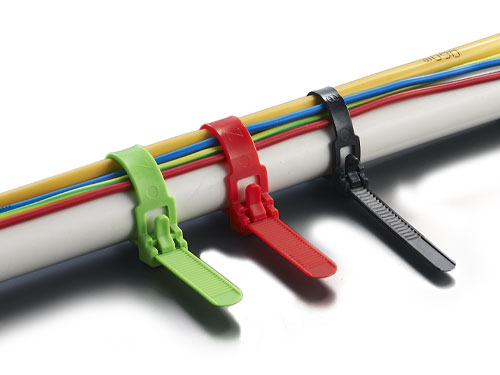
The releasable design typically incorporates a small tab or pawl-release lever on the head that disengages the ratchet, allowing the tie to be loosened and reused. The release mechanism does add a small amount of complexity to the moulding and can affect the tie's maximum strength, but for most outdoor applications where reusable fastening is desirable, the trade-off is well worth it. When selecting a releasable tie for outdoor use, verify that the release mechanism operates smoothly after accelerated ageing—some designs can become stiff or brittle in the sun if the release tab is made from the same unmodified nylon as the strap. Quality designs ensure the release tab material is equally UV-stabilized and remains operable over the product's intended service life.
If you expect to reposition ties regularly, look for a design with a clearly identifiable release tab and a strap with sufficient flexibility to be threaded and unthreaded multiple times without cracking. View examples of outdoor-rated fastening solutions with reusable features.
Key Factor 4: Load Ratings and Safety Factors
Beyond the material and UV concerns, the mechanical load the tie must withstand should be estimated realistically. Outdoor bundles can accumulate wind load. A cable bundle on a pole sways and exerts dynamic forces, not just static weight. In these situations, selecting a tie with a higher tensile rating and using multiple ties spaced at intervals may be necessary.
A common practice is to use a tie with a minimum tensile strength at least three times the anticipated maximum load. For dynamic or safety-critical applications (securing overhead cables, for instance), a factor of five is not excessive. Also, consider the tie width and bundle diameter range. A wider strap distributes load over a larger area, reducing pressure on the bundled items. The bundle diameter must fall within the tie's specified range; a tie tightened beyond its minimum diameter may not engage the ratchet fully, while a tie used near its maximum diameter may not provide sufficient locking force.
Manufacturers typically provide these specifications on their data sheets. When evaluating options, look for products that list not just the minimum tensile strength but also the recommended working load across a temperature range. Compare load-rated fastening products for outdoor use.
Selection Summary: Matching the Tie to the Application
To simplify decision-making, here is a practical breakdown by typical outdoor use case:
-
Gardening and light-duty landscaping: UV-stabilized, releasable ties in smaller widths (2.5–3.6 mm). Tensile strength of 8–18 kg is usually adequate. Ease of removal and reuse is prioritised.
-
Holiday and event lighting: UV-stabilized, black or neutral-colored releasable ties. Moderate strength (18–30 kg) to support light fixtures and cabling. Releasability allows annual reconfiguration.
-
Cable management on rooftops and exterior walls: UV-stabilized and heat-stabilised ties, often in heavier gauges (4.8 mm width or more). Working load should be derated for high-temperature exposure. Black carbon-filled PA66 is the standard.
-
Solar panel and electrical enclosure use: Ties may need to meet additional flame-resistance standards (UL 94 V-2 or V-0). Heat-stabilised and UV-stabilised PA66 are common. Releasable designs help during maintenance without requiring specialised cutters in tight spaces.
-
Coastal, desert, or industrial environments: Consider speciality materials if standard PA66 proves inadequate. Ties made from PA12 or acetyl (POM) may offer better resistance to specific chemicals or wider temperature ranges, though they have different strength profiles. Always verify chemical compatibility with the environment.
No single tie is optimal for every outdoor application. The selection process is about understanding the specific environmental stresses and mechanical demands of your situation, then matching those to a product with the right combination of UV stabilization, temperature rating, mechanical strength, and reusability.
Making an Informed Purchase
When you review product listings, look beyond the marketing description. Key pieces of information to check on a data sheet include:
-
Material specification (PA66, PA66 UV, PA66 HS, etc.)
-
UV weathering test data and the standard used (e.g., ASTM G154, ISO 4892)
-
Minimum tensile strength in kg or N and the standard used (e.g., UL 62275)
-
Operating temperature range (both continuous and intermittent)
-
Bundle diameter range
-
Releasable mechanism type and whether the release tab is also UV-stabilized
-
Any third-party certifications (UL, RoHS, REACH)
If this level of detail is not available, the manufacturer may not have done the testing necessary to support the product's outdoor suitability. Reputable suppliers that specialise in fastening components typically provide full data sheets and are able to answer technical questions.
For installers, procurement managers, and maintenance planners who need consistent outdoor fastening performance, taking the time to specify the right product pays back in reduced rework, fewer failures, and a safer installation. When you're ready to compare concrete options, explore detailed specifications of weather-resistant releasable fastening products.