English
 Español
 Français
 Português
 Pусский
Colored Nylon Cable Ties for Easy Cable Identification
Tracing a single cable in a fully loaded patch panel without labels is a familiar frustration for field technicians. When every cable is black or white, the process slows to trial and error — gently tugging on bundles, hoping to feel the right one move. In industrial control cabinets and data centres where downtime is measured in dollars per minute, that guesswork translates directly into extended repair times and an increased risk of disconnecting the wrong line. The core problem isn’t a lack of labelling tools; it’s that labelling is often applied inconsistently or falls off over time. A simpler approach works with the cable itself: making its function visible at every touch point.
Colour coding is one of the oldest and most reliable visual sorting methods. In the field of cable management, it moves beyond simple aesthetics when tied to recognised standards. The ANSI/TIA-606-B standard for telecommunications infrastructure administration provides a detailed colour scheme for identifying cable types and termination points. For instance, it recommends blue for horizontal cables, orange for demarcation points, green for network connections, purple for common equipment, and yellow for auxiliary circuits. While this standard specifically addresses telecommunications spaces, the principle is widely adopted across industrial electrical work, automation panels, and even structured home wiring. Instead of reading a printed tag, a technician instantly recognises a circuit’s role by the colored fastener on the bundle — a split-second cue that works even in low light or tight spaces.
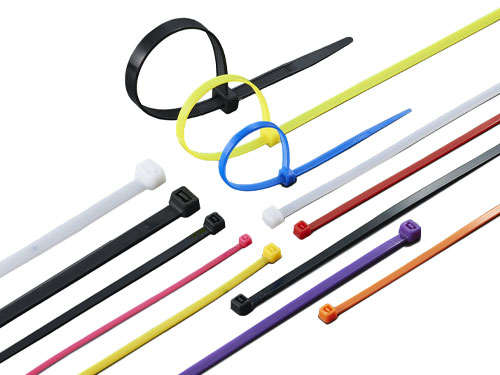
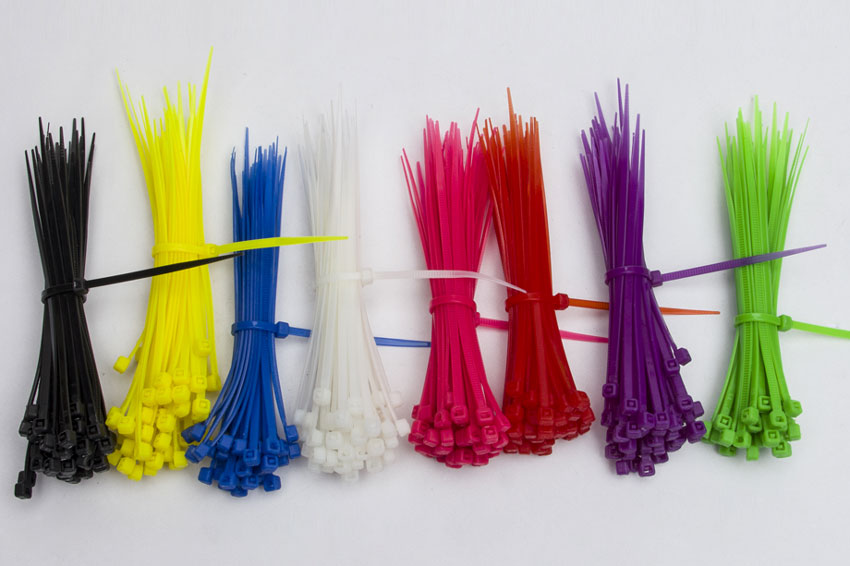
To implement colour identification, installers commonly turn to colored cable ties, which serve both as bundling devices and permanent visual markers. The advantage of using a fastener itself as the identifier is that it stays in place for the life of the installation. Unlike adhesive labels that can peel off in heat or humidity, a cable tie remains mechanically locked on the bundle. When selecting these fasteners, the choice of material matters significantly. Polyamide 6/6, the most widely used engineering plastic for this type of fastener, can be compounded with stable pigments that resist fading under UV exposure. Carbon black and certain inorganic pigments provide the best colour retention outdoors, which is why black remains dominant; however, colourants stabilised for outdoor use have made bright reds, blues, yellows, and greens equally viable for long-term installation in sun-exposed areas. For indoor applications, such as structured cabling in climate-controlled facilities, pigment stability is less critical, and the colour palette expands considerably.
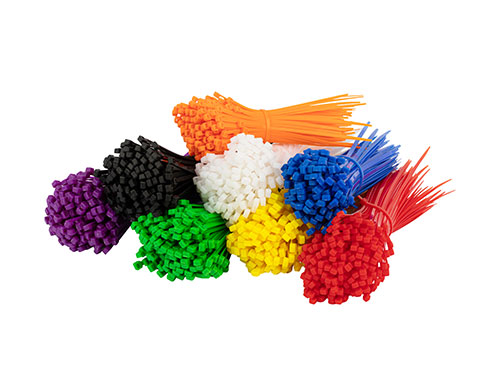
Applying a standardised colour system requires planning a palette that maps colours to functions. A common approach in industrial settings is to dedicate one colour to safety-critical circuits, another to control signals, and a third to power distribution. In datacenters, the TIA-606-B scheme provides a ready-made framework that technicians familiar with the standard will recognise immediately. Regardless of the scheme chosen, consistency across all cabinets, floors, and facilities is what turns colored ties from a nice-to-have into a time-saving asset. Documenting the colour legend inside the cabinet door or in maintenance records ensures that new team members can interpret the system without guesswork. This is especially helpful during emergency repairs when the original installer isn’t available. For those building or renovating structured cabling environments, exploring pre-colored self-locking fasteners designed for visual identification can simplify the initial setup by providing a coordinated range of colours that are ready to use out of the bag.
Balancing Colour and Physical Performance
While colour is a visual feature, it should never compromise the mechanical demands of the application. The pigments used in colouring polyamide can, in some cases, slightly affect tensile strength or elongation. Reputable manufacturers test their colored products to the same performance standards as their natural or black equivalents. When evaluating colored fasteners for load-bearing applications, it’s important to check whether the product’s datasheet lists tensile strength values for each colour, not just for the natural material. For outdoor environments, UV resistance depends on both the base polymer stabilisation and the pigment’s ability to block or absorb UV radiation. For example, a red cable tie in an area with intense sunlight may fade over time if the pigment is organic rather than mineral-based. A UV-stabilized nylon compound paired with lightfast colourants ensures both holding strength and colour remain reliable through years of exposure. This is particularly relevant in solar farms, rooftop installations, and outdoor event rigging where cable identification must remain legible for maintenance crews.
Another practical factor is temperature. Polyamide 6/6 generally performs between -40°C and 85°C continuously, with short-term peaks higher. Colored products from quality manufacturers maintain this range, but some pigments can shift hue at extreme sustained temperatures. For applications like engine bays or industrial ovens, black ties are often the default, but specific high-temperature colored variants exist when visual sorting is required in hot zones. Checking the product’s continuous operating temperature rating, not just the melting point, will prevent surprises in the field.
Integrating Colour Coding into Installation Workflows
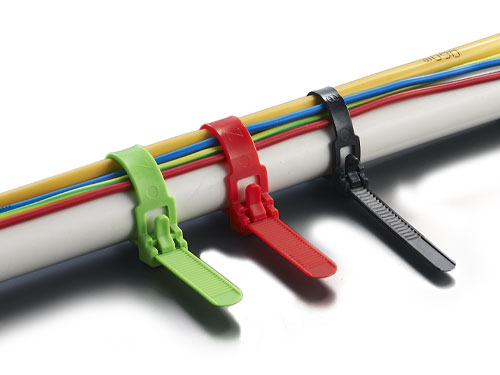
Moving from monochrome to colour-coded fastening doesn’t require new tools or training — just a deliberate step in the procurement and installation process. Many electrical contractors and panel builders now treat colored ties as a standard material alongside wire markers and heat-shrink labels. A single project might use five or six colours consistently across all control cabinets, making it easy for maintenance electricians to quickly isolate a motor control circuit from a safety interlock loop. This small change in material specification reduces tracing time in fault-finding scenarios and lowers the cognitive load during complex rewiring tasks. For panel shops and OEMs that build modular systems, adopting reliable colored bundling solutions that resist fading can become a value-added feature that customers appreciate when they open a cabinet for the first time.
The Role of Quality in Colour Durability
Not all colored fasteners age the same way. Lower-quality products may use surface dyeing rather than through-colored resin, which means the colour exists only on the outer skin and can abrade or chip off when the tie is tightened or rubbed against adjacent surfaces. Through-colored resin, where the pigment is mixed into the polymer before moulding, ensures that a scratch reveals the same colour underneath. This is especially important in high-vibration environments where tie bodies rub against each other or against cable jackets. Additionally, resistance to chemicals and oils matters in manufacturing plants and automotive environments. A red tie that turns pink after a month of exposure to cutting fluids loses its identification function. Specifying ties that are oil-resistant as well as colourfast keeps the colour coding accurate over time.
For teams managing multiple sites or large-scale retrofits, standardising on a single supplier’s colour range guarantees consistency across projects. This eliminates the frustration of finding that the “blue” from one batch doesn’t match the “blue” from another — a common issue when colours are not strictly controlled. In situations where colour consistency must match corporate branding or specific safety standards, reviewing a coordinated product family of colored identification ties helps avoid the patchwork look that comes from mixing suppliers.
Making the Switch Without Overcomplicating It
Changing the way cable bundles are identified doesn’t need a large project budget. Start with one control cabinet or one server rack, implement a simplified colour legend, and document the results over a few maintenance cycles. Technicians almost immediately report fewer instances of having to physically trace cables by hand, and fault resolution times drop. The material cost difference between black and colored ties is usually marginal, and any small premium is absorbed by the labour savings on the first avoided misidentification. Over the life of a facility, the cumulative benefit of being able to visually confirm a circuit’s identity from a distance far outweighs the upfront investment in a few bags of colored fasteners.
If you are currently planning a new structured cabling project or upgrading an older installation that has become hard to navigate, you may want to specify colored fastening hardware from the outset. Boese offers a line of self-locking polyamide ties in a wide array of consistent, through-colored options designed to support clear cable identification. The range covers multiple sizes and tensile strengths, so you can explore Boese’s colored cable tie selection here to see how the available colours might fit into your identification scheme.
Closing Thought
In an era where every minute of downtime is scrutinised, small visual cues can make a significant operational difference. A fastener that both secures and identifies a cable replaces a two-step process (fasten, then label) with a single reliable action. It’s a straightforward way to bring order to increasingly complex cabling systems without adding layers of documentation that may not survive in harsh environments. Whether you follow a formal industry standard like TIA-606-B or develop your own colour logic, the goal is the same: make it easy for the next person who opens that cabinet to immediately know what they’re looking at.