English
 Español
 Français
 Português
 Pусский
Top Industrial Applications for Double-Locking Nylon Cable Ties in 2026
Industrial fastening is not a topic that generates much excitement — until a single failed tie causes a production line shutdown, a warranty claim, or a regulatory non-compliance notice. Ask any maintenance engineer who has traced a wiring fault back to a loose cable tie that chafed through insulation over months of vibration, and you will hear a story that begins with “it was just a zip tie” and ends with an unplanned outage.
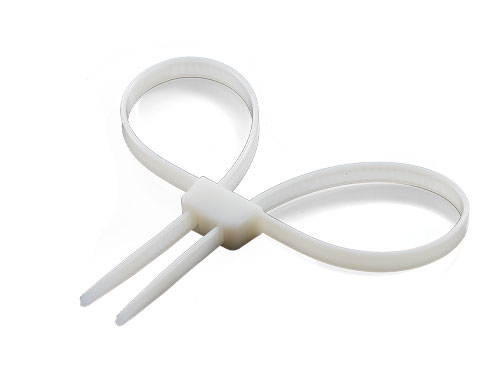
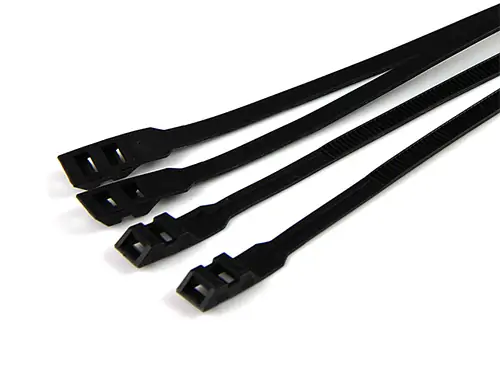
The component at the centre of this conversation is a speciality fastening device with a dual-tooth locking mechanism — one that offers 50% greater tensile strength than conventional single-lock designs. In 2026, as industrial environments become more demanding and regulatory standards more stringent, specifying the right fastener for the right application has moved from an afterthought to a critical design decision.
This article examines five industrial sectors where high-retention fastening solutions are delivering measurable value — and what procurement teams should look for when evaluating specifications.
1. Automotive Wire Harness Assembly: Vibration Is the Silent Killer
Modern vehicles contain between 1.5 and 3 kilometres of wiring, secured at hundreds of points throughout the chassis, engine compartment, and interior. Each attachment point represents a potential failure if the fastener loosens over time.
In engine compartments, temperatures swing from -40°C to above 120°C. In the chassis, constant road vibration works against every fastened joint. A conventional single-lock nylon fastener, over tens of thousands of miles, can gradually lose clamping force as the pawl and tooth interface micro-wears. The result: wiring that shifts, rubs against metal edges, and eventually shorts — a failure mode that is both dangerous and expensive to diagnose.
Automotive-grade fastening devices with dual-sided teeth on both strap surfaces create two independent locking points rather than one, significantly reducing the risk of vibrational loosening. The dual-lock head also allows the strap to form a more circular, uniform bundle — an important detail when securing sensitive cable insulation that can be damaged by uneven pressure. For wire harness assemblies destined for electric vehicle battery compartments, where access for post-production rework is extremely limited, first-time reliability is non-negotiable.
If you are specifying fastening components for an automotive wire harness program, evaluating high-retention dual-lock fastening solutions early in the design phase can prevent costly rework after SOP (start of production).
2. Railway Cable Management: When Fire Standards Dictate Every Component
Railway rolling stock operates under some of the strictest fire safety regulations in any industry. The European standard EN 45545-2, last updated in December 2023, sets requirements for the fire behaviour of all materials and components used on railway vehicles — right down to the smallest fasteners. A cable tie that fails to meet the required fire performance classification can render an entire subassembly non-compliant.
Beyond fire resistance, railway applications present unique challenges: constant vibration from rail joints, exposure to cleaning chemicals, and the need for 30-plus-year service life without maintenance access. Fasteners used to secure cabling within carriage interiors, underframe equipment, and roof-mounted HVAC systems must maintain their mechanical integrity even after decades of exposure.
The dual-tooth locking mechanism matters here because it provides redundancy. If vibration or material ageing compromises one locking tooth, the second tooth remains engaged. This fail-safe characteristic aligns with the safety philosophy underlying railway engineering, where single points of failure are systematically eliminated. For project engineers responsible for specifying railway-compliant cable fastening components, verifying EN 45545-2 fire behaviour classification and long-term thermal ageing data is an essential step in the qualification process.
3. Solar Farm Installations: A 20+ Year Outdoor Test
A utility-scale solar farm represents an extreme environment for any polymer component. Fasteners are exposed to direct ultraviolet radiation, temperature cycling from subzero to over 85°C, and in many cases, contact with galvanised steel mounting structures that can accelerate chemical degradation.
Standard PA66 fasteners without UV stabilisation have an anticipated outdoor service life of only one to two years before embrittlement begins. Even weather-resistant grades typically reach seven to nine years, well short of the 25-year design life of a solar installation. The cost implications extend far beyond the fastener itself: premature failure requires technicians to traverse solar arrays, replacing individual ties, an exercise in both labour cost and safety risk.
This is where material selection intersects with locking design. Fasteners manufactured from PA12 or PA612 with integrated UV inhibitors can deliver 20 to 24 years of outdoor weather resistance. When combined with a dual-locking mechanism that maintains clamping force as the polymer ages and loses marginal flexibility, the system-level reliability improves substantially. For EPC contractors managing solar farm BOS (balance of system) component selection, weather-resistant dual-lock fastening components specified with UV-stabilised engineering polymers provide documented longevity that aligns with project lifecycles.
4. Sustainable Manufacturing: Performance Without the Carbon Cost
The global cable ties market reached approximately 1.5billionin2024andisprojectedtoapproach1.5billionin2024andisprojectedtoapproach2 billion by 2030. Within this growing market, sustainability has become a genuine procurement factor — driven both by corporate ESG commitments and by regulations such as the EU's Carbon Border Adjustment Mechanism.
Recent material innovations have demonstrated that recycled nylon fasteners can match prime-material mechanical performance. Independent testing of 100% post-industrial recycled PA66 fasteners has shown mechanical characteristics on par with virgin materials, while reducing raw material CO₂ emissions by up to 90%. Other manufacturers have introduced fasteners with a 36% lower carbon footprint using post-industrial recycled nylon, certified to UL 62275 and UL 2809 standards for traceability.
The dual-locking configuration contributes to sustainability indirectly: a fastener that maintains its clamp force over the product lifecycle reduces the likelihood of rework and replacement. Fewer field failures mean fewer technician visits, less packaging waste from replacements, and ultimately a lower total environmental footprint. For sustainability managers evaluating environmentally certified industrial fastening solutions, verifying third-party certifications — UL 2809 for recycled content, RoHS, and REACH compliance — is becoming standard due diligence.
5. DataCentrer Infrastructure: Clean Bundling at Scale
A hyperscale data centre contains hundreds of thousands of cables — power distribution, fibre optic networking, copper Ethernet — all requiring organised routing for airflow management, maintenance access, and fault tracing. Poor cable management in a data centre increases cooling costs, complicates troubleshooting, and in extreme cases creates hot spots that shorten equipment lifespan.
Data centre fastening requirements are deceptively demanding. Bundles must be tight enough to maintain organised routing but not so tight that they deform or damage high-speed data cables. The fasteners must not degrade and release particulate matter into the controlled environment. For operators building to Tier III or Tier IV standards, every component in the cable pathway contributes to overall facility reliability ratings.
The smooth, rounded bundle geometry produced by a dual-sided locking head — with teeth engaging evenly from both sides — reduces the risk of localised pressure points that can deform fibre optic cables and affect signal integrity. For data centre infrastructure teams sourcing high-reliability cable management fasteners, specifications covering tensile strength retention, halogen-free material composition, and operating temperature range should be verified against the facility's lifecycle requirements.