English
 Español
 Français
 Português
 Pусский
How to choose the right self-locking nylon cable zip tie size?
A maintenance technician once ordered a bulk pack of what looked like the right fasteners for a control panel upgrade. The ties looked sturdy, the price was right, and the project was behind schedule. Within three weeks, bundles had slipped. Some ties had cracked. Others were so long that their tails snagged on adjacent wiring, creating a new hazard. The problem wasn‘t the product’s quality—it was the size.
Choosing the correct bundling fastener isn‘t just about grabbing something that looks “about right.” Get it wrong, and you face everything from loose cable management to safety risks. Industry data from 2025 shows that 61% of operation sites face recurring cable arrangement issues, with poor fastener selection being a leading contributor. A 2022 survey also found that 63% of premature fastener failures traced back to improper selection or counterfeit materials.
This guide walks you through exactly how to choose the right size—covering bundle diameter, tensile strength, width, length, and environmental factors—so your next installation stays secure.
The Four Dimensions That Actually Matter
Many buyers make the mistake of selecting fasteners by length alone. In reality, a proper sizing chart includes four interconnected dimensions:
Length determines whether a tie can wrap around the bundle and still leave enough tail to engage the locking head properly. Too short, and installation becomes difficult or impossible. Excessively long, and you create waste and sharp tails that can be a hazard.
Width directly impacts durability and holding strength. Narrower ties (around 2.5mm) are flexible for light-duty use, while wider ones (up to 7.6mm or more) provide greater resistance to stress. Wider ties also distribute force better, reducing the risk of breakage under heavy loads.
Tensile strength is perhaps the most critical and most overlooked factor. This rating indicates the minimum load a tie can withstand before breaking. Light-duty applications—such as organising a few network cables in a server rack—may only require 18 lbs of tensile strength. But heavy bundles or vibration-prone environments demand much higher ratings. According to industry standards like UL 62275, tensile strength must be matched to the bundle diameter and weight.
Bundle diameter is the actual circumference of the items being secured. A tie‘s listed maximum bundle diameter isn’t just a suggestion—it‘s the upper limit of what the fastener can safely wrap around. Exceed it, and the locking mechanism may fail to engage fully.
Step 1: Measure Your Bundle Diameter—The Right Way
Before you even look at a size chart, measure what you are securing.
If the cables or wires are already grouped, use a calliper to measure the diameter directly. If they aren‘t yet bundled, estimate based on the number and thickness of items that will be grouped.
There‘s a quick calculation you can use: wrap a string or a flexible measuring tape around the bundle, note the circumference, and divide by π (3.14) to get the diameter. Then add 20 to 30 per cent to determine the minimum tie length needed—this extra length ensures a proper wrap and enough overlap for a secure fastening.
For example, if the measured bundle diameter is 30mm, you‘ll want a tie that can accommodate at least 36-39mm. That means looking at ties with a listed bundle diameter of 40mm or more.
A common mistake is underestimating the bundle size, leading to ties that are forced closed, damaging the locking pawl in the process. Use acalliperr for accuracy, and remember that fasteners should allow for slight movement to avoid creating stress points.
Step 2: Match Tensile Strength to the Real Load
Once you know the bundle size, the next question is: how much holding force do you actually need?
For small, lightweight bundles in typical office or household use, a tensile strength of 18 to 50 pounds is usually sufficient. An 18 lb rating, for instance, is commonly found on 4-inch (100mm) ties, handling bundles up to about 22mm in diameter.
For general electrical bundling and control panel work, 40 to 50 lb ties are standard. An 8-inch (200mm) tie with 50 lb tensile strength can secure bundles up to 55mm in diameter.
For industrial or heavy-duty applications—think large power cables, hoses, or bundles subject to vibration—ties with tensile strengths of 120 lb and above are required. A 7.6mm wide heavy-duty tie can deliver 120 lb of holding force, while a 9.0mm extra-heavy-duty version reaches 175 lb.
As a rule of thumb, select a tie with a tensile strength that exceeds the expected load on the bundle. A 0.01tiethatfailscostsfarmorethana0.03 tie that lasts.
Step 3: Consider Where—and How—the Fastener Will Be Used
Size isn‘t just about physical dimensions. The environment matters just as much.
Indoor vs. outdoor. Outdoor applications demand UV resistance. Standard natural or white ties lack the carbon black additive that blocks ultraviolet radiation. Over time, UV breaks down polymer chains, turning a once-flexible tie into brittle fragments. For outdoor use—solar arrays, rooftop cable trays, or garden equipment—always choose black ties or those explicitly rated for UV exposure.
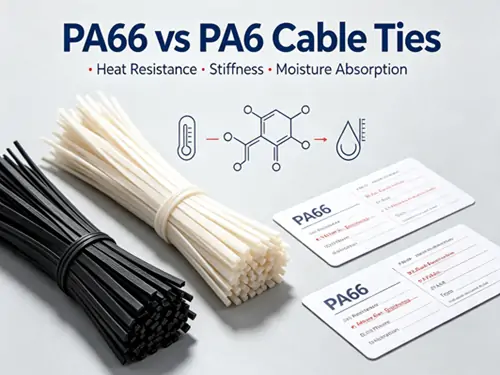
Temperature extremes. Standard PA66 fasteners typically operate from -40°C to 85°C. But near heat sources—under a car hood, inside industrial ovens, or alongside HVAC equipment—heat-stabilised grades are essential. Heat-stabilised PA66 can withstand continuous temperatures up to 120°C without losing tensile integrity. These are specifically engineered for automotive and high-heat industrial applications.
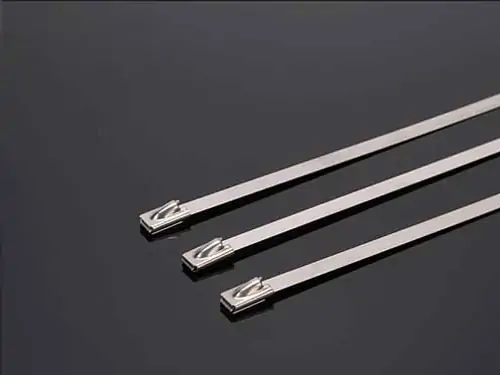
Chemical exposure. In automotive manufacturing plants, oil and grease are everywhere. In marine environments, salt spray is a constant threat. For chemical exposure, look for fasteners made from virgin PA66, which offers high resistance to oils, lubricants, paints, varnishes, and alkalis. Some applications—like battery acid exposure—require moving beyond nylon entirely to polypropylene or stainless steel alternatives.
Vibration. Manufacturing workshops, transportation equipment, and mechanical transmission systems generate constant vibration. A fastener that doesn‘t have adequate tensile strength for the load will stretch and loosen over time, creating a loose loop that loses holding power. Selecting a tie with a working diameter 40 to 60 per cent larger than the cable bundle helps accommodate thermal expansion and vibration-related movement.
Step 4: Account for Space Constraints and Accessibility
Sometimes the limiting factor isn‘t the bundle—it’s the space around it.
In tight or confined spaces, such as inside a small electronic device or a crowded junction box, a shorter tie is more practical. Excess material can interfere with other components or make installation difficult.
For large open areas—server rooms, industrial cable trays, or outdoor cable runs—longer ties can be used to bundle larger cable groups. But avoid excessive length, as long tails left untrimmed can snag on nearby equipment or pose a safety hazard to maintenance personnel.
Also consider how the tie will be installed. If the tie is being applied in freezing conditions, standard PA66 becomes stiffer near 0°C but remains workable. Some speciality formulations address low-temperature flexibility for cold-weather installations. For indoor room-temperature work, standard ties are perfectly adequate.
Step 5: Validate Against Industry Standards
One final check before placing an order: does the product meet recognised standards?
UL certification—specifically UL 94V-2 or V-0 flammability ratings—indicates the material‘s fire performance. UL 94V-2 is standard for general-purpose use, while V-0 is mandatory for certain electrical and EV applications.
For automotive and industrial applications, UL 62275 certification (Type 2S/21S) represents the highest grade, ensuring assemblies meet stringent regulatory requirements.
ASTM D638 provides the testing framework for tensile strength verification. When a product claims a specific tensile strength, that claim should be backed by ASTM-compliant testing.
For marine or shipboard installations, IEC 60092 certification is relevant, outlining requirements for fixed electrical systems on vessels.
Professional Fastening Solutions from Boese
Getting the size right is half the battle. The other half is sourcing fasteners that consistently meet their specifications—batch after batch, in real-world conditions.
If you are looking for fasteners with verified tensile ratings, documented material compositions, and third-party certifications, consider products from Boese. Their lineup includes standard-duty ties for everyday electrical work, heat-stabilised PA66 options for high-temperature environments, and heavy-duty variants for industrial bundling applications. All products are manufactured with virgin PA66 and carry UL 94V-2 certification.
To explore a selection of precision-sized fasteners for your specific application, browse the full bundling strap collection.
For projects requiring custom lengths, specific colours, or tailored tensile ratings, contact Boese‘s engineering team to discuss your requirements.
Final Checklist for Fastener Selection
Before you finalise your next order, run through these five checks:
- Have you measured the bundle diameter accurately (using callipers, not guesswork)?
- Does the tie’s listed maximum bundle diameter exceed your measurement by at least 20%?
- Does the tensile strength rating exceed the expected load on the bundle?
- Have you considered environmental factors—UV, temperature range, chemical exposure?
- Does the product carry relevant certifications (UL, RoHS, or industry-specific standards)?
One size does not fit all. But with a clear understanding of bundle diameter, tensile strength, environmental demands, and space constraints, you can confidently select the right fastener every time. No more guessing. No more field failures. Just secure, professional installations that last.